Waiorau
After the First World War, a number of large stations were divided into runs and offered by ballot to returned servicemen. In 1924 Robert (Bob) Joseph Lee bought one of these runs, Run 625: 16,000 acres of high country and some lower ground for wintering stock. Bob named it Waiorau, Māori for "many waters".
He fenced the property so the sheep could be summered on the mountain tops and brought back to the valley in winter to be fed. In those early years, wool from the Merino sheep was Waiorau's sole income.
In 1965 Bob's son, John Allandale Lee, bought Waiorau from his father. John and Mary Lee married in February 1969.
The autumn muster
Eighty percent of Waiorau was above 1,400 metres and often snowbound for four or five months. Sheep left on the tops would not have survived the winter, so each autumn they had to be mustered to lower ground before the snow arrived.
In the early years a team of eight musterers set off from the homestead on horses or on foot, after a 4.30am breakfast, each with four or five dogs. They brought the sheep down to a holding paddock at the Meg Hut, beside the Meg River.
Once the sheep were sorted, the straggle muster took place, because there were always some missing sheep to account for. Some years the musterers had to snow rake: when the snow was too deep for the sheep to walk through, they walked together to stamp a track and pulled the sheep out of the snow onto it. And a few double fleeces would show up: sheep that had avoided the previous muster and grown two years or more of wool, hidden among the rocks.
The 1991 sheep rescue
After a very heavy snowfall in June 1991, a group of American skiers, including Bill Koch and Justin Wadsworth, were skiing on top of the range in September when they found a mob of 26 sheep snowed in among some rocks. The sheep had had nothing to eat for three months. A yard was made in the snow with the groomer and the sheep were mustered into it. Seventeen survived and were shorn a month later.
Snow Farm
John's dream was to build a cross-country ski area on Waiorau. Groomed nordic trails were unknown in New Zealand until Snow Farm opened in 1990.
Snow Farm was sold to a trust in 2012, and nordic skiing there is run by the Pisa Alpine Charitable Trust.
The first races
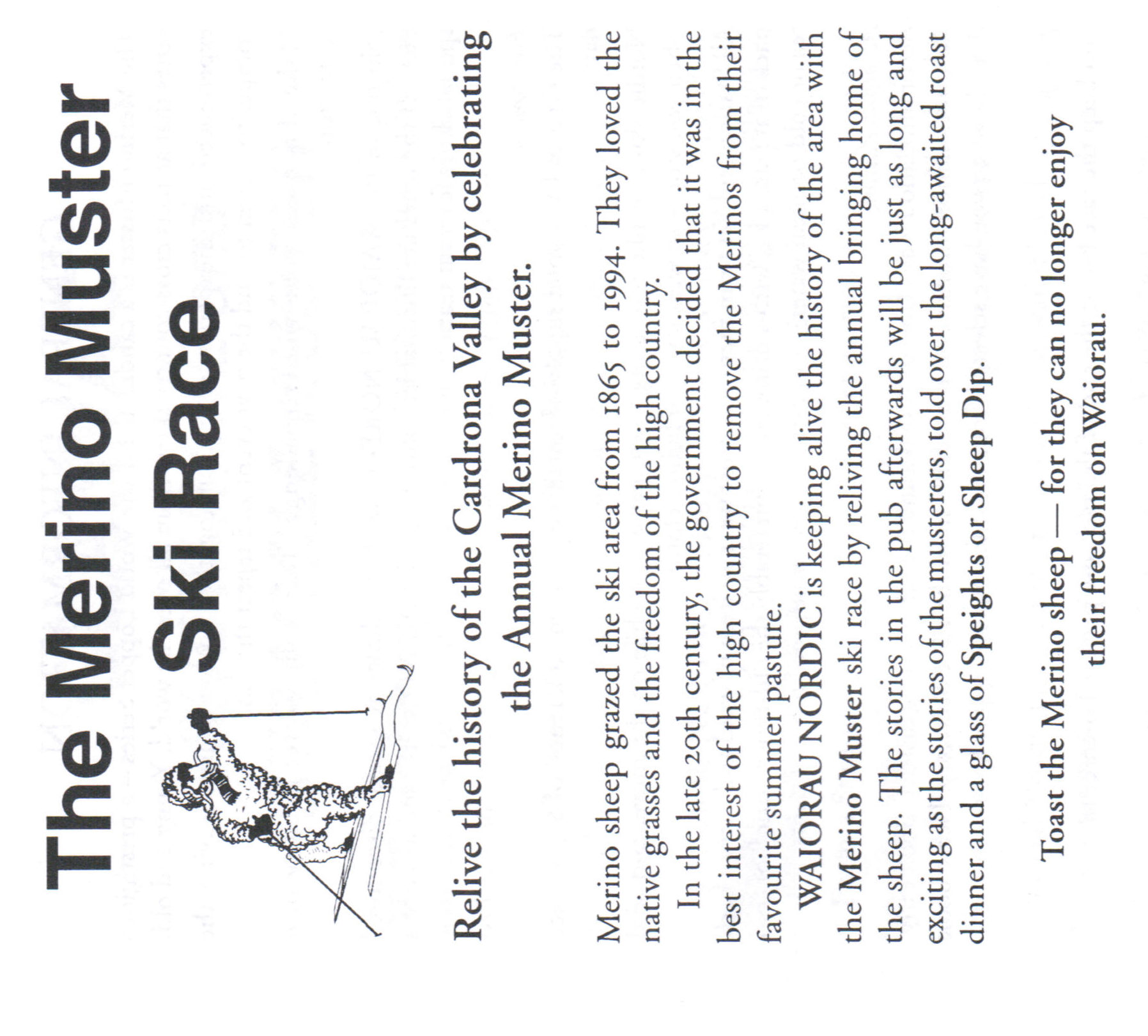
Before the Merino Muster there were two earlier races: one in the 1980s at Cardrona Ski Area, and a small long-distance race at Snow Farm in 1990, organised by Andreas Hefti, whose dream was to create a major international race in New Zealand. Trial races were held in 1993 and 1994.
The first formal Merino Muster was held in September 1995, sponsored by the animal health division of CSL Ltd. A massive storm hit just before the start, but the race went ahead after a short delay.
From 1995 to 1997 the Merino Muster was 21 km, the Snow Rake 10 km and the Straggle Muster 5 km. As New Zealand skiers improved, the distances grew to match the Kangaroo Hoppet: 42 km for the Merino Muster, 21 km for the Snow Rake and 7 km for the Straggle Muster.
In 1998 the race was marketed to rugby supporters, with rugby games played in the snow after the race. It drew 400 competitors.
An international race
Between 1995 and 2013, Merino Muster winners came from Slovenia, Japan, Finland, Russia, Norway, Australia, Great Britain and the USA.
The 2014 race was the 20th Merino Muster. Joining the Worldloppet family of races was a long-term goal, and in 2014 the Merino Muster was a candidate for Associate Member of Worldloppet.
Bringing the sheep down from the snow was a tough experience, and regardless of conditions on race day the race takes place in honour of those fine individuals who developed our nation.
From Merino Muster Cross Country Ski Race: The First 20 Years (2014). Original copy written by John Lee, edited by Shirley Lee, Shirley Jones, Mary Lee and many other willing helpers. Read the full booklet (PDF)